
Quantitative Chemistry: A Comprehensive Question & Answer Guide
Master essential concepts! Access detailed NCERT solutions and Exemplar problems in PDF format, crucial for Class 12 board exam success.
Quantitative chemistry centers on the measurement of chemical species’ amounts – a cornerstone of analytical work. It’s about precise numerical determinations, unlike qualitative chemistry which focuses on identification. Students often seek resources like quantitative chemistry questions and answers PDF to solidify understanding.
This field utilizes mathematical principles and statistical analysis to interpret experimental data. Mastering concepts like the mole, stoichiometry, and solution concentrations is vital. NCERT solutions for Class 12 Chemistry provide a foundational base, aligning with most Indian education boards’ curricula.
Furthermore, tackling NCERT Exemplar problems enhances problem-solving skills, preparing students for board exams and competitive entrances. These resources, often available as a PDF, offer a structured approach to learning and practice, boosting confidence in tackling complex calculations.
The Mole Concept: Fundamental Calculations
The mole concept is central to quantitative chemistry, providing a bridge between microscopic entities (atoms, molecules) and macroscopic amounts (grams). Understanding Avogadro’s number (6.022 x 10²³) is crucial for converting between moles, mass, and number of particles.
Students frequently utilize quantitative chemistry questions and answers PDF resources to practice these conversions. NCERT solutions for Class 12 offer step-by-step explanations of mole calculations, essential for exam preparation. Mastering these fundamentals unlocks more complex stoichiometric problems.
NCERT Exemplar problems provide challenging applications of the mole concept, often requiring multi-step calculations. Accessing these as a PDF allows for convenient offline practice, reinforcing understanding and building confidence in tackling quantitative challenges.

Avogadro’s Number and Molar Mass
Avogadro’s number (6.022 x 10²³ entities/mole) defines the number of particles in one mole, linking microscopic and macroscopic worlds. Molar mass, the mass of one mole of a substance (grams/mole), is derived from atomic masses on the periodic table.
Successfully applying these concepts requires practice, and quantitative chemistry questions and answers PDF materials are invaluable. NCERT solutions for Class 12 demonstrate how to calculate molar mass and use it in conjunction with Avogadro’s number.
NCERT Exemplar problems, often available as a PDF, present more complex scenarios involving these concepts, strengthening problem-solving skills. These resources are vital for mastering stoichiometric calculations and achieving exam success.
Calculating Moles from Mass and Vice Versa
Converting between mass and moles is fundamental in quantitative chemistry. The formula moles = mass / molar mass is key, alongside its rearrangement: mass = moles x molar mass. Accurate calculations depend on correctly identifying the substance’s molar mass from the periodic table.
Quantitative chemistry questions and answers PDF resources, including NCERT solutions for Class 12, provide ample practice with these conversions. These materials demonstrate step-by-step solutions, clarifying common errors.

NCERT Exemplar problems, often found as a downloadable PDF, offer more challenging scenarios, enhancing your ability to apply these concepts in complex stoichiometric calculations and real-world applications.
Stoichiometry: Reaction Calculations
Stoichiometry involves calculating reactant and product quantities in chemical reactions using balanced equations. Mastering this requires understanding mole ratios – the proportional relationships between substances. These ratios, derived from the balanced equation, are crucial for predicting yields.
Numerous quantitative chemistry questions and answers PDF resources, particularly NCERT solutions for Class 12, focus on stoichiometric calculations. These materials provide detailed examples, aiding comprehension.
NCERT Exemplar problems, often available as a PDF download, present more complex scenarios, demanding a deeper understanding of stoichiometric principles and their application to limiting reagents and percentage yield determinations.
Balancing Chemical Equations
Balancing chemical equations is foundational to stoichiometry, ensuring the law of conservation of mass is upheld. It involves adjusting coefficients to equate the number of atoms of each element on both sides of the equation.
Many quantitative chemistry questions and answers PDF resources, including NCERT solutions for Class 12, provide practice exercises on balancing equations. These resources often start with simpler equations and progress to more complex ones.
NCERT Exemplar problems, frequently found as a downloadable PDF, offer challenging scenarios requiring a strong grasp of balancing techniques. Mastering this skill is vital for accurate stoichiometric calculations and understanding chemical reactions.
Mole Ratios in Chemical Reactions

Understanding mole ratios is central to stoichiometric calculations, allowing prediction of reactant and product quantities. These ratios, derived directly from balanced chemical equations, represent the proportional relationships between substances involved in a reaction.
Numerous quantitative chemistry questions and answers PDF materials, particularly NCERT solutions for Class 12, emphasize practice with mole ratio problems. These resources demonstrate how to convert between moles of different substances.
NCERT Exemplar problems, often available as a PDF download, present complex scenarios requiring application of mole ratios to determine limiting reagents and theoretical yields. Proficiency in this area is crucial for exam success.
Limiting Reagent and Percentage Yield
Determining the limiting reagent – the reactant fully consumed – is vital for calculating the maximum product formed. This concept, heavily featured in quantitative chemistry questions and answers PDF resources, relies on stoichiometric calculations and mole ratios.
NCERT solutions for Class 12 Chemistry provide step-by-step guidance on identifying limiting reagents and calculating theoretical yields. Many PDF compilations of practice problems focus on these calculations.
Percentage yield, comparing actual yield to theoretical yield, assesses reaction efficiency. NCERT Exemplar problems, often found in PDF format, challenge students to analyze yield discrepancies and understand factors influencing reaction outcomes.
Solution Chemistry: Concentrations and Dilutions
Understanding solution concentrations – molarity, molality, and normality – is fundamental in quantitative analysis. Numerous quantitative chemistry questions and answers PDF materials emphasize these calculations, crucial for determining solute amounts in a solvent.
NCERT solutions for Class 12 Chemistry offer detailed explanations and worked examples of concentration calculations. These resources, often available as PDF downloads, cover topics like converting between concentration units.
Dilution calculations, including serial dilutions, are also frequently addressed. NCERT Exemplar problems, accessible in PDF format, provide practice in applying dilution formulas and understanding their practical applications.
Molarity, Molality, and Normality
These concentration units are core to quantitative chemistry, and mastering them is vital for success. Many quantitative chemistry questions and answers PDF resources dedicate significant sections to differentiating and applying molarity, molality, and normality.
NCERT solutions for Class 12 Chemistry, often found as downloadable PDFs, provide step-by-step guidance on calculating each concentration unit. They emphasize understanding the differences based on solute and solvent quantities.
NCERT Exemplar problems, also available in PDF format, offer challenging practice problems. These problems require converting between units and applying them to stoichiometric calculations, solidifying comprehension.
Dilution Calculations and Serial Dilutions
Understanding dilution is fundamental in quantitative analysis, frequently tested in quantitative chemistry questions and answers PDF materials. Mastering the M1V1 = M2V2 equation is crucial, and NCERT solutions for Class 12 Chemistry, often available as PDF downloads, provide ample practice.
Serial dilutions, involving successive dilutions, require careful calculation to achieve desired concentrations. NCERT Exemplar problems, accessible in PDF format, present complex scenarios demanding a strong grasp of dilution principles.
These resources emphasize understanding how dilution affects molarity and applying this knowledge to solve real-world problems, preparing students for board exams and beyond.

Titration: Principles and Calculations
Titration, a core technique in quantitative chemistry, is heavily featured in quantitative chemistry questions and answers PDF resources. Understanding equivalence points, indicators, and stoichiometric calculations is paramount, often covered extensively in NCERT solutions for Class 12 Chemistry, readily available as PDF files.
Acid-base and redox titrations require precise calculations to determine unknown concentrations. NCERT Exemplar problems, found in PDF format, challenge students with complex titration scenarios, demanding a thorough understanding of the underlying principles.
These materials emphasize accurate data analysis and the application of titration principles to solve quantitative problems, vital for exam success.
Gravimetric Analysis: Determining Mass
Gravimetric analysis, a cornerstone of quantitative chemistry, is thoroughly addressed in quantitative chemistry questions and answers PDF study guides. Mastering precipitation reactions and accurately determining the mass of a precipitate are key skills, often reinforced through NCERT solutions for Class 12 Chemistry, conveniently available in PDF format.
Calculating percentage composition from gravimetric data requires precise measurements and stoichiometric understanding. NCERT Exemplar problems, accessible as PDF downloads, present challenging scenarios that test a student’s ability to apply these concepts.
These resources emphasize minimizing errors and achieving accurate mass determination, crucial for exam preparation;
Precipitation Reactions and Stoichiometry
Precipitation reactions form the basis of many gravimetric analysis techniques, extensively covered in quantitative chemistry questions and answers PDF resources. Understanding the stoichiometry involved – the quantitative relationships between reactants and products – is vital for accurate calculations.
NCERT solutions for Class 12 Chemistry, often available as a downloadable PDF, provide step-by-step guidance on balancing equations and determining mole ratios in these reactions. NCERT Exemplar problems, also in PDF format, offer more complex scenarios.
These materials emphasize predicting precipitate formation and applying stoichiometric principles to determine the mass of the precipitate formed.

Calculating Percentage Composition from Gravimetric Data
Gravimetric analysis relies on accurately determining the mass of a substance to calculate its percentage composition – a core skill addressed in quantitative chemistry questions and answers PDF materials. NCERT solutions for Class 12 Chemistry, frequently found as a PDF download, detail the process.
These resources demonstrate how to calculate the percentage of a specific element or compound within a sample, based on the mass of the precipitate obtained. NCERT Exemplar problems, also available in PDF format, present challenging scenarios.
Mastering these calculations is crucial for exam preparation and understanding analytical techniques.
Volumetric Analysis: Determining Volume
Volumetric analysis, a cornerstone of quantitative chemistry, centers on precisely determining the volume of a solution needed to react completely with an analyte – a topic thoroughly covered in quantitative chemistry questions and answers PDF resources. NCERT solutions for Class 12 Chemistry, often available as a PDF, provide step-by-step guidance.

This includes mastering techniques like acid-base titrations and redox titrations. NCERT Exemplar problems, accessible in PDF format, offer complex scenarios to hone your skills.
Understanding volume calculations is vital for accurate quantitative analysis and exam success.
Acid-Base Titrations and Indicators
Acid-base titrations are fundamental to volumetric analysis, determining an unknown concentration via neutralization reactions – a key focus within quantitative chemistry questions and answers PDF materials. NCERT solutions for Class 12 Chemistry, frequently found as a downloadable PDF, detail the calculations and principles involved.
Crucially, understanding indicators is paramount; these substances signal the endpoint of the titration through distinct color changes. NCERT Exemplar problems, often available in PDF format, present challenging titration scenarios;
Mastering these concepts is essential for accurate analysis and exam preparation.
Redox Titrations and Endpoints
Redox titrations, involving oxidation-reduction reactions, are vital in quantitative analysis, frequently addressed in quantitative chemistry questions and answers PDF resources. These titrations determine the concentration of an oxidizing or reducing agent, demanding precise endpoint detection.
Unlike acid-base titrations, redox titrations often lack a sharp color change, necessitating the use of indicators sensitive to redox potential or employing potentiometric methods. NCERT solutions and Exemplar problems (available as PDF downloads) provide detailed examples.
Understanding these principles is crucial for accurate results and successful exam performance.

NCERT Solutions & Exemplar Problems
NCERT Solutions are foundational for Class 12 Chemistry students, significantly impacting board exam scores due to widespread curriculum adoption. Complementing these, NCERT Exemplar problems offer advanced practice, crucial for solidifying understanding – both readily available as a quantitative chemistry questions and answers PDF.
These resources are particularly important for the CBSE Class 12 Term 1 Board Exam, providing a comprehensive approach to mastering quantitative chemistry concepts. Working through these problems builds analytical skills and problem-solving abilities.
Effective exam preparation relies heavily on utilizing these PDF materials.
Class 12 Chemistry: Key Concepts and Applications
Class 12 Chemistry heavily emphasizes quantitative chemistry, demanding a strong grasp of concepts like the mole concept, stoichiometry, and solution chemistry. Mastering these is vital for success, and resources like NCERT solutions and Exemplar problems – often found as a convenient quantitative chemistry questions and answers PDF – are invaluable.
These concepts aren’t merely theoretical; they have practical applications in various fields, including pharmaceuticals, environmental science, and materials science.
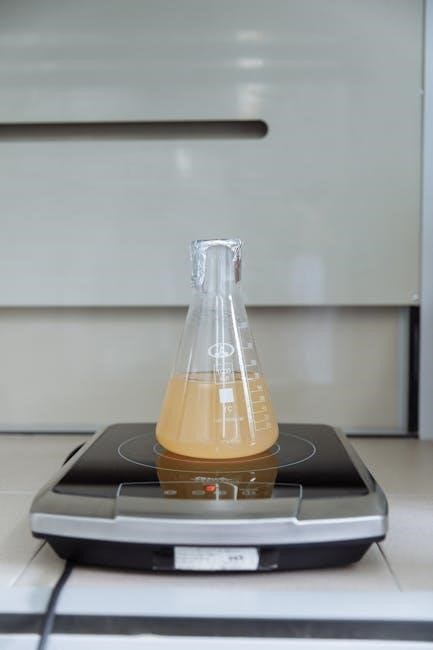
Utilizing these resources strengthens problem-solving skills and prepares students for higher education and professional challenges.
Importance of NCERT Exemplar Problems for Exam Preparation
NCERT Exemplar problems are crucial for solidifying understanding beyond textbook exercises, particularly in quantitative chemistry. Often available as a compiled quantitative chemistry questions and answers PDF, they present challenging scenarios requiring application of core principles like stoichiometry and solution concentrations.
These problems are designed to test analytical skills and promote deeper conceptual clarity, mirroring the complexity of questions found in board exams. Working through these examples builds confidence and improves problem-solving speed.
They are especially important for the CBSE Class 12 Term 1 Board Exam, enhancing preparation significantly.
Common Errors and Troubleshooting
When tackling quantitative chemistry problems, especially those found in a quantitative chemistry questions and answers PDF, students frequently encounter errors related to unit conversions and significant figures. Incorrectly applying the mole concept or misinterpreting stoichiometry are also common pitfalls.
Troubleshooting often involves carefully reviewing calculations, ensuring balanced chemical equations, and verifying the correct use of formulas for molarity and percentage yield. A systematic approach, checking each step, is vital.
Pay close attention to identifying the limiting reagent and understanding the implications for product formation. Practice with diverse problem types builds accuracy.
Precision vs. Accuracy in Quantitative Analysis
Understanding the difference between precision and accuracy is fundamental in quantitative chemistry, and crucial when working through a quantitative chemistry questions and answers PDF. Accuracy reflects how close a measurement is to the true value, while precision indicates the reproducibility of measurements.
High precision doesn’t guarantee accuracy; repeated errors can yield precise but incorrect results. Conversely, a measurement can be accurate on average, even with low precision.
Minimizing errors through careful technique, calibrated instruments, and proper data analysis enhances both. Evaluating results critically, considering potential sources of error, is essential for reliable conclusions.
Sources of Error and Mitigation Strategies
When tackling a quantitative chemistry questions and answers PDF, recognizing potential error sources is vital. Systematic errors, stemming from faulty instruments or methods, consistently skew results in one direction. Random errors, due to unpredictable fluctuations, cause variability.

Mitigation involves instrument calibration, using high-purity reagents, and employing appropriate techniques. Repeating measurements and statistical analysis help minimize random error’s impact. Proper technique, like careful weighing and volumetric measurements, is crucial.
Understanding error propagation through calculations is also key. Thorough documentation and critical evaluation of results are essential for reliable quantitative analysis.