
Article Plan: Ankle Fracture Exercises PDF
This article details a comprehensive plan for ankle fracture recovery, focusing on physiotherapy exercises often found in downloadable PDF guides. It covers stages, protocols, and resources.
Recovering from an ankle fracture demands a structured rehabilitation approach, often guided by a physiotherapist and supplemented with a home exercise program. These programs, frequently provided as PDFs, are crucial for regaining strength, range of motion, and balance. Common among adults over 50, ankle fractures necessitate consistent effort.
Early intervention, whether through casting or surgery, sets the stage for successful recovery. Understanding the specific exercises – ankle pumps, alphabet tracing, and progressive strengthening – is vital. Adhering to weight-bearing protocols post-surgery is also key to optimal healing and a return to activity.
Understanding Ankle Fracture Types
Ankle fractures vary significantly, influencing the rehabilitation pathway and the specific exercises prescribed in PDF guides. Some fractures remain anatomically aligned and are managed non-surgically with casting, while others, particularly those unstable during stress tests, may require surgical intervention.
The type of fracture dictates the initial weight-bearing restrictions and the progression of exercises. Understanding whether surgery was performed is crucial when interpreting a PDF exercise plan, as protocols differ substantially between surgical and non-surgical approaches to recovery.
Non-Surgical Management with Casting
PDF exercise guides for ankle fractures treated with casting typically emphasize early range-of-motion exercises to maintain joint flexibility. These often include ankle pumps and alphabet tracing, performed while the cast is on, to minimize stiffness and swelling.
The focus is on movements that don’t directly stress the fracture site. As healing progresses, PDFs may introduce gentle isometric exercises. Weight-bearing progression is carefully controlled, guided by physician instructions, and detailed within the PDF.

Surgical Treatment and Rehabilitation
PDF rehabilitation programs following ankle fracture surgery are phased, starting with protected range-of-motion exercises. These guides detail early exercises focusing on reducing swelling and regaining initial movement.
Progressive strengthening exercises, like isometric contractions and theraband work, are introduced as bone healing allows. Weight-bearing protocols, clearly outlined in the PDF, dictate when and how much weight can be applied. Advanced exercises build proprioception and prepare for a return to activity.
The Role of Physiotherapy in Ankle Fracture Recovery
Physiotherapy is crucial post-ankle fracture, and PDF exercise plans are often central to treatment. However, referral patterns to physiotherapy can be inconsistent, potentially due to uncertainty regarding optimal timing and intensity.
These PDF guides provide structured exercise progressions, ensuring patients safely regain strength, range of motion, and balance. Access to well-designed PDFs empowers patients to actively participate in their recovery journey, complementing clinical sessions.
Referral Patterns and Uncertainty
Varied referral rates to physiotherapy following ankle fractures suggest a lack of standardized protocols. Uncertainty exists amongst clinicians regarding the ‘ideal’ time to initiate rehabilitation, impacting patient access to crucial PDF-based exercise programs.
This inconsistency may stem from differing opinions on fracture stability, patient co-morbidities, and available resources. Clear guidelines and readily available, physiotherapist-approved PDF resources could improve consistency and optimize recovery outcomes.
Early Stage Exercises (PDF Focus)
Initial PDF exercise plans prioritize reducing swelling and restoring basic ankle movement. These commonly include gentle ankle pumps and alphabet tracing exercises, performed frequently throughout the day.
PDF guides emphasize pain-free range of motion, avoiding forceful movements. Early mobilization, as outlined in these resources, is crucial to prevent stiffness and promote circulation. Proper form, detailed in the PDFs, is essential to avoid re-injury during this vulnerable phase of recovery.
Phase 1 Exercises: Range of Motion & Swelling Control (PDF Content)
PDFs for Phase 1 concentrate on regaining ankle flexibility and minimizing post-injury edema. Key exercises include consistent Ankle Pumps – pointing toes up and down – to encourage blood flow.
Alphabet Tracing, carefully illustrated in the PDFs, gently moves the ankle through its full range. These exercises are typically performed several times daily, focusing on pain-free movement and controlled repetitions, as detailed within the downloadable guides.
Ankle Pumps
Ankle Pumps, a foundational exercise in early ankle fracture rehabilitation PDFs, involve repeatedly pointing your toes upwards towards your shin, then downwards away from you. This simple movement, often demonstrated with clear illustrations in the PDF guides, promotes circulation and helps reduce swelling.
Perform 10-20 repetitions, several times a day, focusing on a controlled motion. PDFs emphasize performing this exercise while seated or lying down for optimal comfort and effectiveness.
Alphabet Tracing
Alphabet Tracing, frequently detailed in ankle fracture exercise PDFs, is a range-of-motion exercise where you “write” the letters of the alphabet with your big toe. This gentle movement improves flexibility and helps regain control over ankle movement post-injury.
PDFs often suggest performing this slowly and deliberately, focusing on completing each letter fully. Aim for one to two repetitions of the entire alphabet, several times daily, as guided by your physiotherapist.

Phase 2 Exercises: Strengthening (PDF Content)
Phase 2, commonly outlined in ankle fracture exercise PDFs, focuses on rebuilding muscle strength around the ankle joint. This stage typically begins once pain and swelling have subsided from the initial phases.
PDFs emphasize a gradual progression, starting with isometric exercises – contracting muscles without movement – followed by resistance training using Therabands. These bands facilitate dorsiflexion, plantarflexion, inversion, and eversion, progressively increasing resistance as strength improves.
Isometric Exercises
Ankle fracture recovery PDFs frequently detail isometric exercises as a crucial component of Phase 2 strengthening. These exercises involve contracting the ankle muscles against an immovable resistance, without joint movement.
Common examples include pushing the foot upwards against a wall (dorsiflexion), downwards (plantarflexion), inwards (inversion), and outwards (eversion). Holding each contraction for 5-10 seconds, repeating several times, builds initial strength and prepares the ankle for more dynamic movements.
Theraband Exercises (Dorsiflexion, Plantarflexion, Inversion, Eversion)
Ankle fracture exercise PDFs commonly incorporate theraband (resistance band) exercises in Phase 2 to progressively strengthen ankle muscles. These bands provide variable resistance for dorsiflexion (pulling foot up), plantarflexion (pointing foot down), inversion (turning sole inward), and eversion (turning sole outward).
Begin with light resistance, gradually increasing as strength improves. Controlled movements through a full range of motion are key, typically performing 10-15 repetitions per exercise.
Phase 3 Exercises: Proprioception & Balance (PDF Content)
Ankle fracture exercise PDFs often dedicate Phase 3 to restoring proprioception – your body’s awareness of its position in space – and balance. These exercises are crucial for functional recovery and preventing re-injury. Common exercises include single leg stance, initially with support, progressing to unsupported.
Balance board or wobble board exercises further challenge stability. PDFs detail progression, duration, and safety precautions for these vital components of rehabilitation.
Single Leg Stance
Ankle fracture exercise PDFs typically introduce single leg stance as a cornerstone of Phase 3 rehabilitation. Begin by holding onto a stable surface for support, gradually reducing assistance as balance improves. Focus on maintaining a neutral spine and avoiding hip hiking.
PDFs often prescribe holding times (e.g., 30 seconds) and repetitions. Progress by performing the exercise with eyes closed, or on an uneven surface, increasing the challenge.
Balance Board/Wobble Board Exercises
Ankle fracture exercise PDFs frequently incorporate balance board or wobble board exercises within Phase 3 to enhance proprioception and stability. Start with both feet on the board, then progress to single-leg use, maintaining a controlled, upright posture.
PDF guides emphasize small, controlled movements, avoiding large, jerky motions. These exercises challenge the ankle’s ability to react to instability, crucial for return to activity.

Advanced Exercises & Return to Activity (PDF Guidance)
Ankle fracture exercise PDFs detail advanced movements like heel raises and toe raises, building calf strength and improving gait. These are typically introduced after successful completion of Phase 3 exercises.
PDFs often provide guidance on proper form and progression, emphasizing controlled movements and listening to your body. Returning to activity should be gradual, following the PDF’s recommended timeline and avoiding overexertion.
Heel Raises
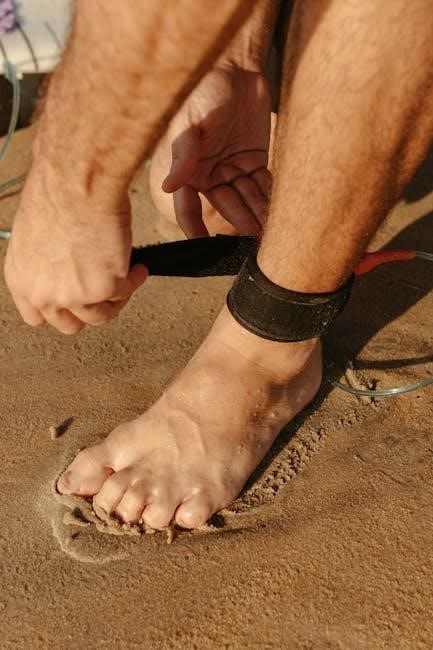
Ankle fracture exercise PDFs commonly include heel raises as a crucial component of advanced rehabilitation. These exercises strengthen the gastrocnemius and soleus muscles, vital for ankle stability and push-off during walking.
PDF instructions emphasize performing heel raises slowly and with control, initially using body weight and progressing to added resistance. Proper form—maintaining a straight body and avoiding knee hyperextension—is highlighted to prevent re-injury.
Toe Raises
Ankle fracture exercise PDFs frequently incorporate toe raises to strengthen the tibialis anterior muscle, essential for dorsiflexion and preventing foot drop. These exercises improve walking mechanics and balance post-injury.
PDF guides typically instruct patients to perform toe raises slowly, lifting the toes as high as comfortably possible while keeping the heel on the ground. Progression involves adding resistance bands or performing single-leg toe raises for increased challenge.
Weight-Bearing Protocols After Surgery
Ankle fracture exercise PDFs detailing post-surgical rehabilitation emphasize strict adherence to weight-bearing protocols. These are crucial for proper healing and preventing complications. Initial phases often involve non-weight bearing, utilizing crutches or a walker, as outlined in the PDF.
Partial weight-bearing is gradually introduced, guided by the surgeon’s instructions and the PDF’s progression. Full weight-bearing is only permitted when sufficient stability and pain reduction are achieved, as detailed within the exercise plan.
Non-Weight Bearing Phase
Ankle fracture exercise PDFs consistently highlight the initial non-weight bearing phase post-surgery. This typically lasts several weeks, demanding complete avoidance of pressure on the injured limb. PDFs detail exercises performed while non-weight bearing, focusing on range of motion and swelling control – like ankle pumps.
Crutches or a walker are essential during this period, as illustrated in many PDF guides. Strict adherence is vital to protect the healing fracture and prevent displacement, ensuring optimal recovery outcomes.
Partial Weight-Bearing Phase
Ankle fracture exercise PDFs transition to partial weight-bearing, guided by physician approval. This phase introduces gradual load, often starting with toe-touch weight-bearing, progressing to partial weight as tolerated. PDFs emphasize controlled exercises, like short arc quads and heel raises (modified), to rebuild strength.

PDFs detail specific weight percentages and timelines. Proper form is crucial, preventing re-injury and promoting stable healing. Consistent monitoring and adherence to the PDF’s prescribed progression are key.
Life Impacts Following Ankle Fractures
Ankle fracture exercise PDFs often don’t directly address broader life impacts, but recovery significantly influences daily function. Research indicates fractures impact quality of life, potentially leading to activity limitations and psychological distress.
Understanding these impacts highlights the importance of a structured rehabilitation program, as detailed in PDFs. Successful exercise adherence, guided by a PDF, can mitigate long-term functional deficits and improve overall well-being post-injury.
Explorative Study Framework
While ankle fracture exercise PDFs focus on physical rehabilitation, a recent explorative study investigated broader life impacts following these injuries. This framework aimed to understand the multifaceted consequences beyond physical limitations.
The study didn’t focus on exercise protocols themselves, but understanding these impacts underscores the necessity of comprehensive recovery plans – plans often supported by detailed PDF exercise guides – to address holistic patient needs.

Importance of Following a PDF Exercise Plan
Adhering to a structured ankle fracture exercise plan, often delivered as a PDF, is crucial for optimal recovery. Consistency ensures progressive strengthening and range of motion gains, minimizing stiffness and maximizing function.
A well-designed PDF guides patients through phases, preventing overexertion and reducing the risk of re-injury. Following the plan diligently, as prescribed by a physiotherapist, significantly improves long-term outcomes and return to activity.
Consistency and Progression
A PDF exercise plan’s effectiveness hinges on consistent daily practice. Skipping sessions hinders progress and can prolong recovery; Gradual progression, as outlined in the PDF, is equally vital; increasing intensity too quickly risks re-injury.
The PDF should detail clear guidelines for advancing through phases, based on pain levels and functional improvements. Regular adherence, coupled with smart progression, optimizes healing and restores ankle stability, ensuring a successful return to pre-injury activity levels.
Avoiding Re-Injury
A well-structured ankle fracture exercise PDF emphasizes a phased return to activity, crucial for preventing re-injury. Prematurely resuming high-impact movements before achieving sufficient strength and proprioception significantly elevates risk.
The PDF should highlight the importance of continued exercises even after initial recovery, maintaining ankle stability. Ignoring warning signs like pain or swelling, and pushing beyond limits, can easily lead to setbacks. Careful adherence to the PDF’s guidance is paramount.

Finding Reliable Ankle Fracture Exercise PDFs
Locating trustworthy ankle fracture exercise PDFs requires careful consideration. Prioritize resources created or approved by qualified physiotherapists to ensure exercise safety and effectiveness. Seek PDFs from reputable healthcare websites and organizations.
Avoid generic exercise plans; a good PDF will be tailored to fracture type and recovery stage. Online databases can be helpful, but always verify the source’s credentials. A physiotherapist can directly provide or recommend suitable, personalized PDF materials.
Physiotherapist-Approved Resources
Seeking PDFs directly from physiotherapy clinics or professional organizations guarantees exercise quality and safety. Many clinics offer downloadable rehabilitation guides to their patients, often in PDF format. Look for resources endorsed by national physiotherapy associations, ensuring adherence to best practices.
These PDFs are typically designed by experienced professionals, progressing exercises logically. Always confirm the resource’s author qualifications before commencing any new exercise program. Prioritize resources that emphasize proper form and gradual progression.

Online Databases and Healthcare Websites
Reputable healthcare websites, like those of major hospitals or orthopedic societies, frequently host ankle fracture exercise PDFs. Online databases specializing in physiotherapy resources can also be valuable, but require careful vetting. Ensure the information is current and evidence-based.
Always cross-reference exercises with guidance from your physiotherapist. Be cautious of generic PDFs lacking personalization; a tailored program is crucial for optimal recovery. Prioritize sites with clear author credentials and dates of publication.
Account Security & Accessing PDFs (Gmail Login Context)
Many ankle fracture exercise PDFs are shared via email or cloud storage, often requiring a Gmail account for access. Prioritize strong, unique passwords for your Google Account to protect sensitive health information. Regularly review account activity for unauthorized access.

If you encounter login issues, utilize Gmail’s password assistance features. Enable two-factor authentication for enhanced security. Be wary of phishing attempts requesting your credentials; always verify sender legitimacy.
Gmail Login for PDF Access
Accessing your ankle fracture exercise PDF often begins with logging into your Gmail account. Navigate to gmail.com on your computer or utilize the Gmail app on your mobile device. Enter your registered phone number or email address, followed by your password.
Ensure accurate input to avoid login errors. If prompted, complete any security verification steps. Once logged in, locate the email containing the PDF link or access the shared drive where the file is stored.
Password Assistance & Account Recovery
Forgotten your Gmail password and need access to your ankle fracture exercise PDF? Visit the Google Account recovery page. Enter your email address and follow the on-screen prompts. You may be asked to verify your identity through a recovery email or phone number.
Complete the CAPTCHA challenge to prove you’re not a robot. Google offers various recovery options; choose the one that best suits your situation to regain access.