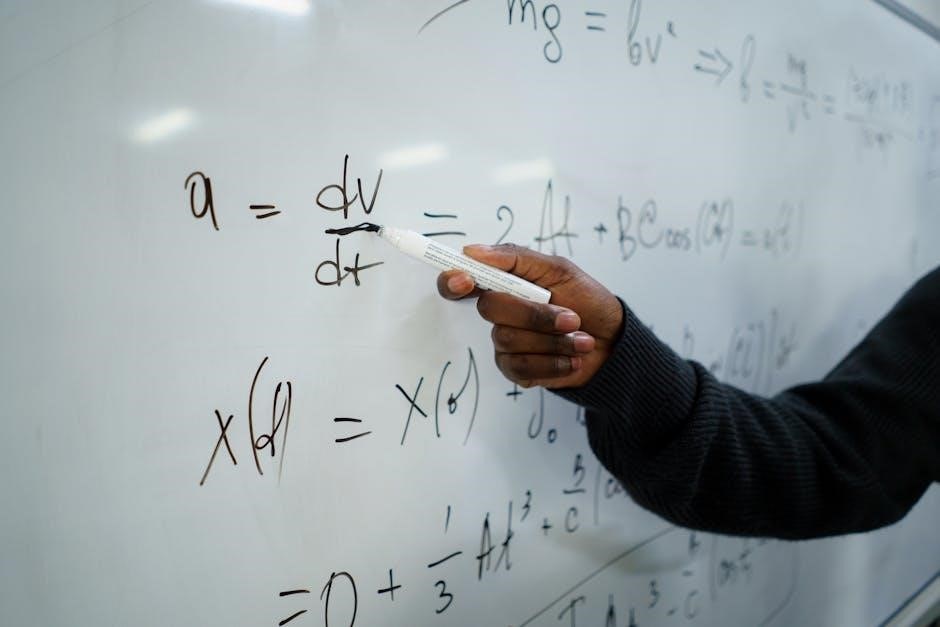
Graphical Numerical Algebraic Calculus seamlessly blends visual, computational, and symbolic methods.
Resources like readily available PDF versions of Finney’s textbook facilitate learning.
This approach, championed by authors like Finney, Demana, Waits, Kennedy, and Bressoud, offers a robust understanding.
What is Graphical Numerical Algebraic Calculus?
Graphical Numerical Algebraic Calculus represents a multifaceted approach to learning calculus, moving beyond traditional methods. It emphasizes understanding concepts through visual representations – graphs – alongside numerical techniques for approximation and problem-solving. Crucially, it maintains a strong foundation in algebraic manipulation and reasoning. This integrated strategy, popularized by the textbook authored by Finney, Demana, Waits, Kennedy, and Bressoud, aims to provide a deeper, more intuitive grasp of calculus principles.
The availability of PDF versions of resources like “Calculus: Graphical, Numerical, Algebraic” significantly enhances accessibility. Students can leverage these digital materials alongside tools like Quizlet for practice and solutions. This holistic method empowers learners to tackle complex problems using a variety of interconnected skills, fostering a more complete and lasting comprehension of calculus.
Historical Context of the Approach
The rise of Graphical Numerical Algebraic Calculus reflects a shift in pedagogical approaches during the latter half of the 20th century. Traditionally, calculus instruction heavily emphasized symbolic manipulation. However, the advent of powerful graphing calculators and computers spurred a movement towards incorporating visual and numerical methods. The textbook by Finney, Demana, Waits, Kennedy, and Bressoud, first appearing in the early 1990s, became a cornerstone of this evolving approach.
The increasing availability of PDF resources, including various editions of the textbook (3rd, 5th, AP Editions), has further democratized access to this methodology. This historical trajectory demonstrates a commitment to making calculus more accessible and intuitive, moving beyond abstract formulas to foster a deeper conceptual understanding. Online tools and platforms like Quizlet complement this evolution, providing supplementary learning materials.
Graphical Approach to Calculus
Graphical methods, central to this calculus style, utilize visual representations – easily found in PDF textbook versions – to explore functions, limits, and derivatives effectively.
Understanding Functions Through Graphs
Graphical representation is foundational in this calculus approach, allowing for intuitive comprehension of function behavior. Utilizing resources like PDF versions of “Calculus: Graphical, Numerical, Algebraic” by Finney, Demana, Waits, Kennedy, and Bressoud, students can visually analyze key characteristics.
Graphs reveal domain, range, intercepts, and symmetry. They demonstrate increasing/decreasing intervals and identify maxima and minima. This visual exploration, enhanced by online graphing tools, complements algebraic manipulation. The textbook’s emphasis on graphical analysis provides a strong conceptual base, making abstract concepts more accessible.
Students can readily observe how changes in a function’s equation translate to graphical transformations, solidifying their understanding. This method fosters a deeper, more lasting grasp of functional relationships.
Limits and Continuity Visually
The graphical approach to limits and continuity, as presented in resources like the PDF of “Calculus: Graphical, Numerical, Algebraic” by Finney et al., emphasizes visual inspection. Students can determine limit existence by examining function behavior as it approaches a specific x-value.
Discontinuities – removable, jump, or infinite – become readily apparent on a graph. The concept of a limit being the y-value the function approaches, not necessarily reaches, is easily grasped visually. Graphical analysis allows for quick identification of points where a function is undefined or not continuous.
This visual understanding complements the algebraic definition of a limit, providing a more intuitive grasp of these fundamental calculus concepts. Online tools and the textbook’s examples reinforce this visual learning process.
Derivatives as Slopes of Tangent Lines
“Calculus: Graphical, Numerical, Algebraic,” available as a PDF, powerfully illustrates derivatives as the instantaneous rate of change, visually represented by the slope of a tangent line. The text and accompanying resources demonstrate how to estimate this slope graphically, drawing tangent lines at various points on a function’s curve.

This visual approach connects the abstract concept of a derivative to a concrete geometric interpretation. Students can observe how a steeper tangent line indicates a larger derivative, signifying a faster rate of change.
Numerical methods, also covered in the textbook, allow for approximation of the derivative’s value. This graphical-numerical synergy, reinforced by online calculators, builds a strong conceptual foundation for understanding derivatives;
Integrals as Areas Under Curves
The “Calculus: Graphical, Numerical, Algebraic” textbook, often found as a PDF resource, emphasizes understanding integrals as the accumulation of infinitesimally small areas. This is visually represented as the area bounded by a function’s curve, the x-axis, and two vertical lines.
The text demonstrates how to approximate this area using rectangles, laying the groundwork for the formal definition of the definite integral. Numerical integration techniques, like the Trapezoidal and Simpson’s Rules, detailed within the book, provide methods for calculating these areas with increasing accuracy.
Graphical tools and online calculators complement this understanding, allowing students to visualize the area and verify their calculations. This approach solidifies the connection between integral calculus and geometric area.
Applications of Graphical Analysis
The “Calculus: Graphical, Numerical, Algebraic” textbook, accessible in PDF format, highlights the power of graphical analysis in solving real-world problems. Visualizing functions allows for the interpretation of rates of change, optimization, and modeling complex phenomena.

Students learn to analyze graphs to determine intervals of increasing/decreasing behavior, locate maxima and minima, and understand function behavior. This is crucial for applications in physics, engineering, economics, and other fields.
Online graphing tools, often used alongside the textbook, enhance this understanding. The graphical approach, combined with numerical and algebraic techniques, provides a comprehensive problem-solving strategy, fostering a deeper conceptual grasp of calculus.

Numerical Approach to Calculus
Numerical methods, detailed in the PDF textbook, approximate solutions when analytical techniques fail.
Techniques like the Trapezoidal and Simpson’s Rule are essential for practical applications.
Numerical Differentiation Techniques
Numerical differentiation provides methods to approximate the derivative of a function using its values at discrete points; This is particularly useful when an explicit formula for the derivative is unavailable or computationally expensive to evaluate. The PDF version of “Calculus: Graphical, Numerical, Algebraic” by Finney, Demana, Waits, Kennedy, and Bressoud details several techniques, including forward, backward, and central difference approximations.
These methods rely on finite difference quotients to estimate the instantaneous rate of change. The accuracy of these approximations depends on the step size (h) used in the calculations; smaller step sizes generally lead to more accurate results, but can also introduce round-off errors. Understanding these trade-offs is crucial for effective application. Furthermore, the textbook provides examples and exercises to solidify comprehension of these vital concepts;
Numerical Integration Methods (Trapezoidal, Simpson’s Rule)
Numerical integration approximates the definite integral of a function, representing the area under its curve. When finding an analytical solution is difficult, methods like the Trapezoidal Rule and Simpson’s Rule offer effective alternatives. The PDF of “Calculus: Graphical, Numerical, Algebraic” thoroughly explains these techniques, demonstrating how they approximate the integral using polynomial interpolation.
The Trapezoidal Rule uses trapezoids to estimate the area, while Simpson’s Rule employs parabolas for a more accurate approximation. Both methods divide the integration interval into subintervals. Simpson’s Rule generally provides higher accuracy for the same number of subintervals, but requires an even number of them. The textbook illustrates these concepts with detailed examples and emphasizes the importance of understanding error bounds associated with each method.
Error Analysis in Numerical Calculus
Error analysis is crucial in numerical calculus, as approximations inevitably introduce inaccuracies. The textbook, “Calculus: Graphical, Numerical, Algebraic,” – available as a PDF – dedicates significant attention to quantifying these errors. Understanding both absolute error and relative error is paramount. Sources of error include truncation (from approximating infinite processes) and rounding (due to finite precision of computers).
The PDF resource details how to estimate error bounds for methods like numerical differentiation and integration. For instance, the Trapezoidal and Simpson’s Rules have established error formulas. Analyzing these errors allows for determining the necessary number of subintervals to achieve a desired level of accuracy. Furthermore, the text explores the concept of propagation of errors, showing how errors in initial data can affect the final result.
Using Spreadsheets and Software for Numerical Solutions
“Calculus: Graphical, Numerical, Algebraic,” often accessed as a PDF, emphasizes practical application. Spreadsheets like Excel and dedicated software packages like Mathematica or MATLAB are invaluable tools for implementing numerical calculus techniques. These tools allow for efficient computation of numerical derivatives and integrals, such as the Trapezoidal and Simpson’s Rules, which are detailed within the textbook.
The PDF version of the text often includes examples demonstrating how to set up these calculations in spreadsheets. Software facilitates exploring the impact of varying parameters, like step size, on the accuracy of the results. This hands-on approach reinforces theoretical concepts and allows students to experiment with different methods. Online calculators and graphing tools further complement these explorations, providing immediate visualization of numerical solutions.

Algebraic Approach to Calculus
Algebraic foundations are crucial, as highlighted in the PDF of “Calculus: Graphical, Numerical, Algebraic.”
Mastering equation manipulation and function analysis unlocks deeper calculus comprehension and problem-solving skills.
Fundamental Algebraic Concepts for Calculus
Fundamental algebraic concepts form the bedrock of calculus understanding, and the “Calculus: Graphical, Numerical, Algebraic” textbook – often found as a PDF resource – emphasizes this strongly. A solid grasp of these principles is non-negotiable for success. Key areas include a thorough understanding of functions, their properties, and various types like polynomial, rational, exponential, and logarithmic functions.
Proficiency in manipulating algebraic expressions – simplifying, factoring, expanding – is essential. Solving equations and inequalities, both linear and non-linear, is also critical. Furthermore, a firm foundation in coordinate geometry, including graphing lines and curves, is vital for visualizing calculus concepts. The textbook, in its various editions, consistently reinforces these algebraic skills as prerequisites for tackling differential and integral calculus. Accessing a PDF version allows for focused review and practice of these foundational elements.
Manipulating Equations and Expressions
Mastering the manipulation of equations and expressions is paramount in calculus, and the “Calculus: Graphical, Numerical, Algebraic” textbook – frequently available as a PDF – provides extensive practice. This involves simplifying complex expressions using factoring techniques, expanding binomials, and combining like terms. Students must become adept at rearranging formulas to isolate variables, a skill crucial for solving applied problems.
Working with rational expressions, including addition, subtraction, multiplication, and division, is also essential. Proficiency in these algebraic manipulations allows for a smoother transition into more advanced calculus concepts. Utilizing a PDF version of the textbook enables focused practice on specific areas of weakness. The ability to confidently manipulate equations and expressions is not merely a skill, but a gateway to understanding the core principles of calculus.
Solving Equations and Inequalities
A cornerstone of calculus, as detailed in resources like the “Calculus: Graphical, Numerical, Algebraic” textbook – often found as a convenient PDF – is the ability to solve equations and inequalities. This encompasses linear, quadratic, polynomial, rational, exponential, and logarithmic equations. Students learn techniques like factoring, completing the square, and utilizing the quadratic formula.
Solving inequalities requires understanding critical values and interval notation. Graphical representations, a key feature of this calculus approach, aid in visualizing solution sets. Accessing a PDF version of the textbook allows for repeated practice and reinforces these concepts. Mastery of these skills is fundamental, as many calculus problems involve finding roots, intercepts, and intervals where functions are positive or negative. The textbook by Finney, Demana, Waits, Kennedy, and Bressoud provides ample examples and exercises.
Polynomial and Rational Functions in Calculus
Polynomial and rational functions form the bedrock of many calculus concepts, thoroughly explored in texts like “Calculus: Graphical, Numerical, Algebraic,” often accessible as a PDF. Understanding their behavior – end behavior, zeros, asymptotes – is crucial. Graphical analysis, a core tenet of the approach, allows visualization of these characteristics.
Calculus operations, such as differentiation and integration, are frequently applied to these functions. The textbook by Finney, Demana, Waits, Kennedy, and Bressoud details techniques for finding derivatives and integrals. Rational functions require attention to vertical and horizontal asymptotes, impacting limits and continuity. A PDF copy facilitates focused study and practice of these essential skills, preparing students for advanced calculus topics and real-world applications.

The Textbook: “Calculus: Graphical, Numerical, Algebraic”
“Calculus: Graphical, Numerical, Algebraic” by Finney, Demana, Waits, Kennedy, and Bressoud is a cornerstone resource, often found as a convenient PDF.
Authors: Finney, Demana, Waits, Kennedy, Bressoud
Ross L. Finney, Franklin D. Demana, Bert K. Waits, Daniel Kennedy, and David M. Bressoud collaboratively authored “Calculus: Graphical, Numerical, Algebraic,” a highly influential textbook. Their combined expertise revolutionized calculus education by integrating three core approaches. Finding a PDF version of their work is common for students seeking accessible learning materials.
Finney and Demana previously established a strong foundation, later enhanced by Waits, Kennedy, and Bressoud’s contributions. This team emphasized visual understanding through graphs, computational skills via numerical methods, and analytical proficiency using algebraic techniques. The textbook’s enduring popularity stems from its clear explanations and comprehensive coverage, making it a valuable resource, often available in digital PDF format, for both students and educators alike.
Editions and Updates (3rd, 5th, AP Editions)
“Calculus: Graphical, Numerical, Algebraic” has seen several editions, including the 3rd and 5th, alongside specialized Advanced Placement (AP) editions. Each iteration builds upon the previous, incorporating updated examples, exercises, and technological integrations. Students often seek PDF versions of these editions for convenient study. The AP editions are specifically tailored to align with the College Board’s AP Calculus curriculum, providing targeted preparation for the exam.
The 5th edition, a popular choice, reflects advancements in technology and pedagogical approaches. Accessing a PDF copy allows for digital annotation and portability. Updates address evolving mathematical standards and enhance the clarity of explanations. Finding reliable sources for these PDF files is crucial for ensuring accurate and complete content, supporting effective learning and exam preparation.
Key Features and Content Coverage
“Calculus: Graphical, Numerical, Algebraic” distinguishes itself through its multi-representational approach, emphasizing visual, numerical, and algebraic understanding. Key features include real-world applications, technology integration, and a focus on conceptual understanding. Content coverage spans limits, derivatives, integrals, and applications of calculus, presented with clarity and rigor. Access to a PDF version of the textbook facilitates focused study and note-taking.
The textbook’s strength lies in its ability to connect abstract concepts to concrete examples. Utilizing a PDF allows students to easily search for specific topics and practice problems. The authors skillfully balance theoretical foundations with practical problem-solving techniques, preparing students for success in calculus and related fields. This comprehensive coverage makes it a valuable resource.
Availability and Cost (Amazon, eBay)
“Calculus: Graphical, Numerical, Algebraic” by Finney, Demana, Waits, Kennedy, and Bressoud is widely available through online retailers. Amazon typically offers both new and used copies, with prices varying based on edition and condition. eBay presents opportunities for finding more affordable options, including older editions. A PDF version can sometimes be found online, though legality should be carefully considered.

Pricing for a physical copy ranges from approximately $30 for used editions to $150 or more for newer ones. The AP Edition generally commands a higher price. Searching both Amazon and eBay is recommended to compare costs and shipping fees. Accessing a PDF can be a cost-effective alternative, but ensure it’s a legitimate source.

PDF Resources and Online Tools
PDF versions of “Calculus: Graphical, Numerical, Algebraic” are accessible online, alongside Quizlet for solutions. Numerous calculus calculators and graphing tools enhance learning.
Finding PDF Versions of the Textbook
Locating PDF versions of “Calculus: Graphical, Numerical, Algebraic” by Finney, Demana, Waits, Kennedy, and Bressoud requires careful navigation. While directly offering copyrighted material is prohibited, students can often find resources through educational institutions or legitimate online repositories.
Searching online using specific keywords like “Calculus Finney Demana Waits PDF” can yield results, but verifying the source’s legality and safety is crucial. Be cautious of websites offering downloads that seem suspicious or require excessive personal information.
Some universities may provide access to digital textbooks for enrolled students. Additionally, exploring online forums dedicated to calculus or AP Calculus may reveal shared resources or links to legally obtained PDF copies. Remember to respect copyright laws and utilize these resources responsibly for educational purposes.
Quizlet for Solutions and Practice
Quizlet emerges as a valuable supplementary resource for students utilizing “Calculus: Graphical, Numerical, Algebraic.” It provides access to expert-verified solutions, specifically for the 5th Edition, eliminating the need for cumbersome solutions manuals or printed PDFs.
Through Quizlet, learners can reinforce their understanding of complex calculus concepts by reviewing worked-out problems and practice exercises. This platform fosters self-directed learning and allows students to identify areas where they require further assistance.
While not a replacement for the textbook itself or a legally obtained PDF version, Quizlet serves as an excellent tool for homework help, exam preparation, and solidifying comprehension of the material presented by Finney, Demana, Waits, Kennedy, and Bressoud.
Online Calculus Calculators and Graphing Tools
Complementing the study of “Calculus: Graphical, Numerical, Algebraic” and its available PDF resources, numerous online tools enhance understanding. Graphing calculators, like Desmos and GeoGebra, visually represent functions, limits, derivatives, and integrals – aligning with the textbook’s graphical approach.
Symbolab and Wolfram Alpha offer step-by-step solutions to calculus problems, aiding in algebraic manipulation and numerical calculations. These tools verify answers and demonstrate problem-solving techniques, reinforcing concepts learned from Finney, Demana, Waits, Kennedy, and Bressoud.
Accessing these resources alongside a digital PDF copy of the textbook allows for interactive learning and deeper exploration of calculus principles. They bridge the gap between theory and application, fostering a more comprehensive grasp of the subject matter.

Advanced Placement (AP) Calculus and the Textbook
AP Calculus aligns closely with “Calculus: Graphical, Numerical, Algebraic,” and its PDF versions.
Finney, Demana, Waits, Kennedy, and Bressoud’s work provides excellent exam preparation and strategic success.
Alignment with AP Calculus Curriculum
The textbook, “Calculus: Graphical, Numerical, Algebraic,” demonstrates a strong alignment with the College Board’s Advanced Placement Calculus curriculum. Its structure and content directly address the topics and skills assessed on both the AP Calculus AB and BC exams. The integration of graphical, numerical, and algebraic approaches provides students with multiple pathways to understanding key concepts, mirroring the AP exam’s emphasis on problem-solving and conceptual mastery.
Access to PDF versions of the textbook allows for convenient study and practice. The book’s coverage of limits, derivatives, and integrals, alongside its focus on applications and modeling, prepares students for the rigorous demands of the AP exam. Furthermore, the textbook’s emphasis on functions, their representations, and their analysis directly supports the AP curriculum’s core principles. Utilizing resources like Quizlet alongside the PDF enhances comprehension and retention.
Preparation for the AP Exam
Utilizing “Calculus: Graphical, Numerical, Algebraic” as a primary study resource provides a comprehensive foundation for the AP Calculus exam. The textbook’s numerous practice problems, aligned with AP exam question types, build crucial problem-solving skills. Accessing a PDF version of the text allows for focused review of specific topics and efficient practice sessions. Supplementing textbook study with online resources like Quizlet, offering solutions and practice questions, further strengthens exam readiness.
The book’s emphasis on conceptual understanding, alongside procedural fluency, is vital for success. Students benefit from the graphical and numerical approaches, enabling them to visualize concepts and verify solutions. Consistent practice with past AP exam questions, combined with thorough review of the textbook’s content – readily available through the PDF – maximizes preparation and confidence.
Strategies for Success in AP Calculus
Mastering AP Calculus requires a multifaceted approach, and “Calculus: Graphical, Numerical, Algebraic” provides an excellent framework. Regularly utilizing a PDF copy of the textbook allows for convenient, focused study sessions. Prioritize understanding the core concepts – graphical representations, numerical methods, and algebraic manipulations – rather than rote memorization. Consistent practice is paramount; work through numerous problems, utilizing solutions available on platforms like Quizlet to identify and correct weaknesses.
Embrace the textbook’s visual and numerical tools to deepen comprehension. Don’t hesitate to revisit foundational algebraic skills. Effective time management during the exam is crucial; practice pacing yourself with full-length practice tests. A well-structured study plan, centered around the PDF textbook and supplementary resources, is key to achieving a high score.